
From First Skills to Mastery: Coaching Juniors at Every Stage
By Coach Hunter Pronovost
There is no single formula for coaching athletes, especially juniors. A young rider learning to navigate a group safely does not need the same coaching as a 17-year-old preparing for a national championship. And an elite junior racing internationally may need something entirely different again.
The training changes, of course. But so does how the coach supports that athlete.
At CCNS, we think about athlete development as a progression. Early on, the priorities are safety, basic skills, enjoyment, and belonging. As athletes gain experience, competition and adventure become increasingly important. Eventually, for those who pursue the sport at its highest levels, the focus shifts toward mastery.
Good coaching means recognizing where an athlete is along that pathway, and helping them take the appropriate next step.
I had the pleasure of speaking with Ben, Nick, and Vivien specifically on their perspectives on coaching athletes at different places on the continuum.
Together, we have spent much of this summer working with junior cyclists at very different points along that progression. Our experiences with the CCAP, New England Devo, Team Bear Junior Devo, and VeloSport offer an interesting look at how coaching evolves along with the athlete.
COACH HUNTER PRONOVOST
SAFETY + SKILL | CCAP Rail Trailers
I’ve coached the CCAP Rail Trailers for more than a decade, leading our mountain bike, road, and cyclocross teams. We are very much a beginner-friendly program. Some kids arrive still learning what it means to ride a “real” bike. Pretty much everyone has not raced, let alone been on a team before.
At this stage, I’m not thinking first about fitness, speed, or race results. I want kids to feel comfortable being themselves. I want them to learn that they can push themselves without being afraid of failing.
For a lot of young riders, even discovering what their limits feel like is new. Many have never pushed themselves to the brink riding up a hill. That experience can actually be kind of startling the first couple of times. So first and foremost, there’s nothing wrong with you if it feels like you can’t do it anymore.
At the same time, there needs to be a payoff for that work. I want them to finish a ride feeling proud that they accomplished something. They should be able to look back and think, I didn’t know I could do that.
To me, safety at this level is about more than helmets, bike handling, and avoiding crashes. It also means creating an environment where a kid feels secure enough to test a limit, fail, recover, and try again.
Riding a bike should be fun. So we try to make games of learning the needed skills.
Who is hesitant? Who charges into everything? Who needs more confidence? Who needs to slow down and think? Those things become much easier to see when kids are playing instead of worrying about whether they are doing something “right.”
Over time, the team itself becomes a big part of the process.
The kids start looking forward to being together. They build relationships that extend beyond practice. They build a relationship with learning, and they build a relationship with me as their coach.
Some kids are very serious. Some are much more playful. Those personalities don’t reveal themselves in one practice. They come out over many rides, weeks, races, jokes, mistakes, and shared experiences.
Eventually, they also start recognizing that the Rail Trailers have a reputation and that they contribute to it. They are no longer just kids who happen to show up for a bike ride. They are part of a team.
Competition comes next.
For a rider’s first race, I want them to know enough about what to expect that they can mostly focus on pushing themselves. But I also tell them something very simple: you just have to get through the first one to learn.
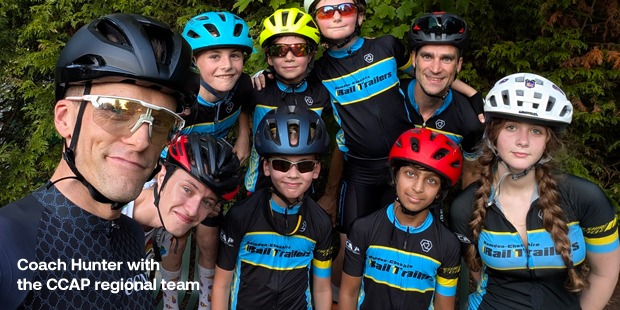
I consider that first race successful if they enjoyed it, or, as is more often the case, they experienced something different from a normal bike ride. After all, that’s racing. You can’t recreate it without the race. The nerves, the pace, getting passed, making a mistake, realizing they can go harder than they thought, all of that gives us something to build on afterward.
You have to experience racing before you can really start learning how to race.
As time goes by, one of the things I start looking for is autonomy.
For example, a junior starts thinking ahead about what equipment they’ll need for cyclocross season. They know what races are coming up. They start anticipating the next thing without me having to put it in front of them.
That tells me cycling has become a priority.
They may not be ready to set sophisticated goals. They may not even know what goals are reasonable yet. But they’re beginning to live the life of an athlete rather than simply participating in a program.
I know better results and more speed can come with time, and opportunities will arise. I hope some of these kids eventually move into programs like NE Devo, Velosport, or other teams that can take them farther into the competitive side of the sport.
But for now, just showing up and sticking with it is success!
COACH BEN WOLFE
COMMUNITY → COMPETITION | CCAP + NEW ENGLAND DEVO
Coach Ben has recently had an opportunity to see junior development from two very different vantage points: working with developing riders at the CCAP summer camp and working regularly with the more experienced athletes of New England Devo.
The difference isn’t simply that one group is faster. As riders mature, the coach’s role begins shifting from primarily teaching and demonstrating toward questioning, guiding, and collaborating.
Ben, what’s different about working with newer kids compared with experienced Devo riders?
With the CCAP side, it’s more about teaching, demonstrating, and creating an environment where they want to learn, where they feel like they can grow and develop without being judged.
With the more experienced riders and racers, it’s more about guiding, questioning, and almost collaborating with them on who they are as riders. What are their strengths and weaknesses? How do those fit within the bigger picture of a team?
As you get higher in the sport, you realize there is a big team aspect to getting results. They can’t just be individual riders anymore. They need to understand how their strengths can help the team and how to recognize opportunities within a race.
So, the fundamentals haven’t disappeared. The athlete simply has enough experience now to begin understanding the nuance behind them.
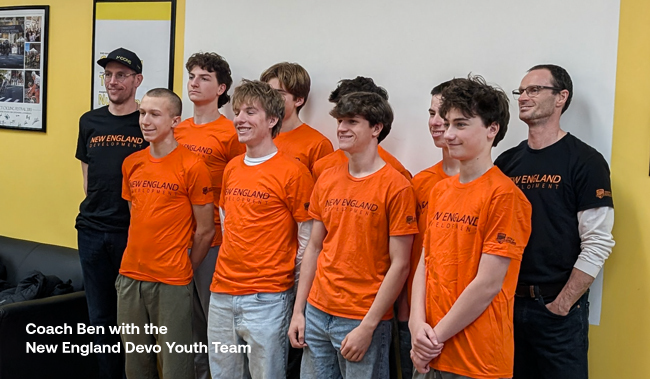
What does an experienced junior need from you that a less experienced rider doesn’t need yet?
They already understand the basics of racing. Now it’s: Did I do my homework on the course? Do I know where the hard hill is? Do I know where I need to be positioned? Who is at this race? What are their strengths?
It’s not just fitness, and it’s not just training. There’s an art to racing.
Even something like “race conservatively” gets misunderstood. That doesn’t mean disengaging from the race and sitting at the back waiting for a sprint. You still need to be at the front, paying attention and recognizing opportunities. Conserving energy means not doing frivolous attacks or chasing things you don’t need to chase.
Early competition teaches a rider how hard they can go. More advanced competition begins teaching them when they should, and shouldn’t, use that ability.
At CCNS, you’ve used the phrase “Golden Retriever Mode.” What’s that?
You chase everything.
Picture somebody throwing a tennis ball and the dog just goes after it no matter what. A lot of bike racers do the same thing.
With young kids, I actually like some impulsive racing because it teaches them things. Go hard. Push a boundary. Blow up. Find out what happens.
As they become more experienced, now we’re trying to craft that. Maybe the plan is just to make the front split on lap one. You don’t need your best power numbers on that lap. Then maybe lap two is when you’re committing.
Don’t go “Golden Retriever Mode” just because you feel good.
It’s important to note that our coached athlete has not become less aggressive. They’ve learned to give that aggression direction.
How do you know when to instruct a junior and when to let them figure something out?
A lot of it comes down to consequences. If it’s a low-consequence skill, let them experiment. Mistakes are valuable teachers. Ask questions before giving answers.
You’re trying to teach them independence. If we’re doing skills on the grass and something doesn’t work, stand back a little. Let them experience it. If it’s high consequence, obviously that’s different.
The goal is to get athletes to understand the principles behind what they’re doing so they can make good decisions themselves. I’d rather see someone commit to something they didn’t think they could do and fail than decide in their head that they can’t do it and never try.
Development isn’t linear, and ability alone isn’t readiness. A talented young athlete still needs patience, curiosity, good habits, and most importantly a reason to love the process enough to continue.
COACH NICK
COMPETITION → MASTERY | BEAR NATIONAL TEAM
At the national level, Coach Nick encounters a another coaching situation. The MTB Bear National riders already possess exceptional fitness and technical ability. At that point, another cornering drill or another watt isn’t automatically the answer.
Nick, when an athlete already has the fitness and technical foundation to race nationally, what do they need from you?
These kids are incredible at riding their bikes. Their bike handling and bike control aren’t really what they need. They’re doing regimented training, but they’re also just spending all day on their bikes. They’re almost one with the bike.
What can become difficult when you’re that invested in something is maintaining balance and groundedness.
It’s very easy to get caught up in the heat of competition and caught up in things that aren’t within your control.
A lot of what we work on is focusing on the things that are within their control and executing those things. That frees up a lot of mental bandwidth and allows them to ride closer to their highest potential.
At this level, mastery isn’t simply accumulating more ability. Sometimes it’s learning how to stop spending energy on things that don’t matter.
Does telling a high-level athlete to loosen up ever sound like you’re just telling them to goof off?
Sometimes goofing off and having more fun is exactly what’s needed! It’s about balance.
These kids can be so Type A and so far toward the other end of the spectrum that getting them to loosen up a little bit actually helps with longevity and sustainability.
You can become so focused on national races and training that you stop doing the local group ride or seeing the people who made the sport fun for you in the first place. Staying connected to that helps keep athletes grounded.
If they are so skilled at this point, how do you support them to make them better?
Part of it is helping them prioritize what actually affects the race.
Maybe a rider is extremely skilled, and there’s a technical line that’s half a second faster. They often can become fixated on hitting that line every lap.
But maybe it’s also high risk. If you miss it, you lose five seconds, or flat a tire, or rip a derailleur off.
You have to understand the tradeoff. Yes, be able to execute that line when you need it. But recognize that gaining half a second there every lap probably isn’t what’s going to win the race.
Knowing how to do something is skill. Knowing when that skill truly matters is much closer to mastery.
COACH VIVIEN
MASTERY | VELOSPORT
With Coach Vivien and Velosport, the progression reaches the sharpest end of junior development. These riders aren’t learning whether they enjoy competition. They’re trying to extract performance as they approach national-team, international, and professional opportunities.
At this point, good coaching becomes highly individualized. However, “more advanced” does not necessarily mean simply doing more.
Vivien, what does coaching look like when you’re working with riders already operating near the top of junior cycling?
Obviously, by my nature, I’m very interested in data. But we don’t just care about numbers. We care a lot about the kids’ psychology, their racecraft, and their technical ability. So I think the approach needs to be holistic.
The technology and data are really in service of making all that learning easier and making it happen quicker.
It’s the same reason you do physiological testing. The purpose isn’t to create more intensity or place more burden on an athlete. It’s to be more precise about what you’re doing and how much you’re doing instead of just blindly saying, “You need more hours.”
At the mastery level, additional information only has value if the coach can turn it into better decisions.
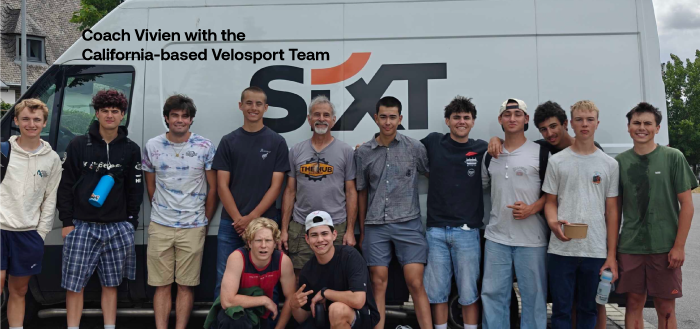
When an athlete is already extremely talented and winning races, how do you figure out what actually needs to improve?
Sometimes the obvious strength isn’t what you need to keep training.
We had one rider who was an absolute monster anaerobically. He has this huge “battery”—he can produce enormous power for short periods. Like, 1000w for 30 seconds powerful! But when we tested him, it became pretty clear that his aerobic capacity was actually the limiter.
The way I explained it to him was: you have this huge turbo that wins races, but you’re burning through it before the finish because the aerobic system underneath it isn’t strong enough. He’ll need that at the next level.
So we basically did a 180 from what his training had looked like before. For a large part of the winter, the emphasis was almost entirely aerobic. The goal wasn’t to make his biggest strength even bigger. It was to build the system that would allow him to actually use that strength when it mattered.
At the mastery level, improvement doesn’t necessarily mean adding more. Sometimes it means identifying the one limitation that prevents an athlete from fully using the abilities they already have.
How do you use data to actually teach race craft?
We always debrief races as a group and individually. We’ll look at files of course. We have other tools to break down how the race actually happened. Then we can compare that with what the athlete experienced.
An athlete might say, “I got into this move, then I got into that move,” and we’ll look at the data and ask, “Okay, when you were in that move, were you pulling full gas?”
Sometimes they’re a little cagey about it. Then you can show them the data.
Now we’re not arguing about someone’s opinion. We can put the subjective experience together with the objective information and have a useful conversation about what actually happened.
The purpose of the data isn’t to catch the athlete doing something wrong. It’s to accelerate self-awareness.
And when it works, what does that look like and result in?
We’ve had riders where you can show them something during the post-race meeting—“Look, you did this, and here’s why it hurt you”—and you see an immediate change in the next race. Like, a full turnaround!
That’s not just getting stronger. That’s race aptitude. That’s actually learning how to race a bike.
We’ll use video the same way. If we think an athlete has a positioning issue, we’ll sometimes put a camera on them. There isn’t much better accountability than watching yourself riding three feet off the wheel and out in the wind.
They see it and go, “Oh. I need to fix that.”
That’s mastery: not perfection, but an increasing ability to observe, understand, adjust, and execute.
It’s true at all levels: it’s not always smooth sailing and you have to know how to say “no,” isn’t that so?
For sure. Sometimes I’m constantly telling an athlete to do less.
We had one very strong rider coming back from a significant injury who had basically been off the bike for three months. When we started rebuilding, it was really from the ground up. At first, riding might only be 30 minutes. If he started having problems, that was the point to stop. He’d repeat that consistently and, when he was ready, we’d add a little more.
Eventually we were able to start calling it training again, but even then we added things very slowly. At first there was essentially no intensity, and the volume was very low. Then we’d introduce one piece, see how he responded, and build from there.
The tendency with talented athletes can be to think, “We need to get them back. We need to do more.” But it was a very measured, balanced approach.
By the time he returned to racing, he was immediately competitive again and went on to have some really strong results.
At the mastery level, good coaching isn’t synonymous with more training. Knowing how much an athlete can absorb and having the patience to build only as quickly as they are ready is part of the expertise. Sometimes the fastest route begins with a coach saying, “That’s enough for today.”
THE ATHLETE CHANGES.
SO SHOULD THE COACHING.
A beginner may need a skill before they can push themselves.
A developing rider needs a community that makes them want to return.
A racer may need to learn when to attack, and when to put the tennis ball down.
An elite athlete may need data, perspective, accountability, or even permission to loosen up.
The hierarchy isn’t a one-way escalator, either. Even accomplished athletes still need safety, community, and enjoyment. The higher the level gets, the easier it can be to forget the things that made the athlete want to ride in the first place.
Good coaching isn’t simply knowing more about training. It’s recognizing where an athlete is today, understanding what they need from you now, and helping them become ready for whatever comes next.